Showing posts with label Story. Show all posts

Thursday, December 7, 2017

Week 15 Story: The Traitor's Kiss

Having a best friend who is also in love with you hard, especially when you would never see them in such a way.

I stared at the book in my hand, my fingers grazing over the intricate cover. Gio had given it to me as a birthday gift. He gave me a book every year. It was a tradition that was started at the beginning of their friendship, when he gave her his copy of Harry Potter to read for her eighth birthday.

I should have known then that went he had felt for me was so much more than what I felt for him. No one gives up their copy of Harry Potter without having some sort of connection to the person it’s being lent to.

“Lancelot is probably one of my favorite heroes” I heard from behind me, and my head snapped up and twisted around to zero in on who it was coming from.

Gio’s younger brother, Paul, leaned against the doorframe, smirking at me with amusement. His eyes were on my face, but brought the book up to my chest, hiding it from his view anyway. This was how it always was, with Paul. He teased, I retaliated, we continued on our merry way.

It was a shame I was also in love with him.

Unlike his brother, Paul was tall, muscular in an obvious way that let you know he worked out. He flaunted it regularly, while Gio hid behind his books and his science and his, well, everything else.They had the same coloring – dark, with dark hair and dark eyes – much like plenty of other Italian families. But Paul was different. He was beautiful in a way that sucked all the air from my chest and threatened to suffocate me. I couldn’t look at him for more than a few moments without feeling my cheeks start to redden.

Which is why my eyes drop to the book pressed to my chest as his own eyes dropped to it as well.

“Of course, you like Lancelet. He’s a jackass.” I muttered, and I could hear Paul’s chuckle from the doorway. Glancing upward, I saw him look hesitant for a moment before pushing off the frame. Taking a step towards me, he tilted his head slightly, his smirk softer than before.

“Happy birthday, Francesca, He said, moving to sit down next to me. I don’t know if he was aware of the fact that my heart skips two beats whenever he said my name. I hope he couldn’t hear it. His arm brushed mine as he sat, the musk of his cologne filling my nose with his closeness.

“Thanks,” I said, placing the book down on my lap and looking up at him. This was a simple conversation. I could handle this. Right?

Wrong.

His eyes were right on mine, a dark pool that seemed to draw me in as soon as they met with mine. We were so close that I could feel his breath falling onto my face, the smell of coffee and mint following. I had never been this close to him before, and examining his face at this angle, I could see there were golden specks scattered throughout his irises.

I was memorized.

“Francesca,” He whispered, making my heart constrict, and I gripped the book in my lap tighter to make sure that he couldn’t see my hands shake. But his eyes were not on my eyes, or my book, but my lips.

I should have been more aware that this was what was coming. I had read about it so many times, it should have been obvious to me. But it still caught me by surprise. Paul caught me by surprised.

He leaned in far enough that his mouth pressed to mine, our noses touching as his hand reached up and intertwined his fingers in my hair. I reacted immediately, my body moving closer. My hands released the hold on the book so that I could cup Paul’s cheeks. I deepened the kiss, tasting his coffee and the mint, reveling in the fact that this was happening.

Paul was kissing me.

A loud noise jostled me. The two of us sprang apart as though we had been shocked, the sound bringing up back to reality. I stared at him for a long moment, his mouth swollen from our kiss, his hair slightly disheveled.

With my wits about me, I turned slightly from Paul’s gaze to find Gio standing in the hallway, a pile of books now a mess on the floor. The look on his face causing my heart to constrict and break into a million pieces. I had no time to move away from Paul before Gio was sprinting down his hallway, away from us.

The look on his face was something I would never forget.

Like he had been stabbed.

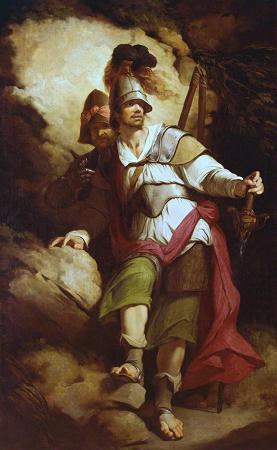
Image Info: Paolo and Francesca da Rimini (Dante Gabriel Rossetti, 1867). Found on Wikipedia.
Author's Note: So in Dante's Inferno, you're only given the outline of what happened in the story of Paolo and Francesca. Basically, Francesca was married to Giovanni (who is extremely crippled and ugly), and she doesn't love him. In fact, she's in love with his younger, attractive brother, Paolo. Paolo and Francesca start an affair after reading the story of Lancelet and Guinevere. Giovanni finds out about this, and he stabs them both to death. Dante placed them in the second level of Hell, assigned to the lustful. In my story, I focused on their story rather than that of Dante's. I made it Francesca's point of view and set it during modern day. Instead of being married, Francesca and Gio are just best friends, and Paul is the attractive brother. It's just a modern, Young Adult romance, and Gio doesn't kill anyone. Though I sort of referenced the stabbing with the last line. 

Bibliography: Dante's Divine Comedy, translated by Tony Kline (2002). Link to online reading.

Thursday, November 9, 2017

Week 12 Story: Interruption

Have you ever looked at someone and realized that you were staring at the most beautiful woman you’ve ever seen?

Brit tilted her head, almost cat-like in its movement, as she stepped toward the young man in front of her. His hair was dark, eyes bright like fairy pools that she had passed getting to this very spot. His cheekbones created a natural contour that the sun caught nicely, and she couldn’t help herself as she reached up to run her fingers along his chiseled jawline.

Normally, she would be wary to approach someone who tried to kill her, but Brit was going to blame that one the fact that Artegall had had no idea who she was.

“I’ve been looking for you.” Brit whispered, a slow smile creeping up onto her face as she dropped her hand and stood there in front of him, unsure what to do now.

The smile that she received back was blinding, and his voice was deeper than she imagined it would be. It was rough, but somehow calming. It was a sound that could have come from her dreams. “Me too.”

The two of them were so lost in one another, they had forgotten that Scudamour – the bastard lord – was there. Brit heard him cough and she dragged her eyes away, still standing close to Artegall as her focused shifted to the man that she had been hiding from for some time, mainly because he had been trying to kill her. But it was for noble reasons, she was assured.

“I hate to interrupt such an… intimate moment,” Scudamour began. Brit got the feeling that he didn’t mind a bit. “But we came here for a purpose. You see, darling Brit, you released my love, Lady Amoret, from her captivity in the Fairy Queene’s court, and while I give you my undying gratitude for that, she is not here with me. I seek to find her. “

Brit sighed. She knew that this was going to be difficult for Scudamour to hear.

As if sensing her tension, Artegall reached out and gripped Brit’s hand, intertwining their fingers and giving them a light squeeze in reassurance.

Brit straightened her back and looked at the lord square in the face. “We need to talk, then.”

Arthegall and Talus in Fairie Queen. Found on Art History Reference.
Author's Note: This part of Britomart's story is when she finds Artegall after seeing him in the enchanted mirror, following him into the Fairie Queen's realm, fighting him and then discovering that he was the same man that she had been searching for this entire time. Meanwhile, Britomart saved a young woman by the name of Amoret, while also pissing off her husband, Scudamour. In my section of the story that I rewrote, I kept the same aspects of the story that go on in this part of the tale. However, I made the language more modern, and I gave Artegall and Britomart a more in depth connection. It's almost as if both of them had been searching for one another, and now they understand one another in a deeper way because of their journey to find one another. I made Scudamour more obnoxious because that's how I saw him in the original story, and I ended it on a cliff hanger to create more suspense. 

Bibliography: How Britomart Ended Her Quest. Stories from the Faerie Queene by Mary Macleod, with drawings by A. G. Walker (1916). Link to online reading.

Friday, October 27, 2017

Week 10 Story: It's a Bad Idea, Me and You

There is something about bad boys, I think, as Kaxo climbs out of bed and stretches his shoulders. We had been at this for weeks, despite the fact that my parents hate him. The tribal tattoos along his shoulders stretch and move, almost like they are alive on his tanned skin. The wolf between his shoulder blades moves as if alive, the skull between its jaws escaping some unknown horror inside. 

What I image Kaxo's tattoo looks like. Found on favim.
It had been weeks since this had started, weeks since my parents kicked me out and sent both of us packing. The entire community backed them. They never liked him; Kaxo was an outsider in their eyes, someone who would never leave up to the impossible standards that they had set for everyone around them.

And I was going to have his child.

We had found out only a few days before, when I had been sick over a long period of days without any other explanation. We couldn’t see a doctor – neither of us had insurance – and I was far too prideful to go to a clinic. So, a pregnancy test it was, and it was positive.

“I’m going to meet Crow.” Kaxo tells me, turning around with that smile that got us in so much trouble in the first place. His best friend is the only one from our old neighborhood that keeps in contact, the only one that believed Kaxo was just as amazing as I believed him to be.

Together, the two of them were going to figure out what Kaxo and I were going to do. With the baby on the way, there was nothing that I could do but sit and let the baby grow.

From what Kaxo has told me, they believe that if my parents believe that if I broke it off with him, if I really prove to them I have come to my senses, they would take me back in. I could have the baby taken care of and when he, or she – Kaxo firmly believes it’s a boy – is born, I leave again.

But the problem is, I don’t know if I can leave Kaxo for that long. I guess we’ll have to see.

________________________________________________________________________________

Author's Note: The original story is The Dog-Husband, and it talks about a young woman who is seduced and has an affair for a man who's a dog during the day, and human during the night. In the original story, when her parents find out, she is exiled and the man is killed. She goes to the beach and has the babies. A crow helps them later on in the story, when the babies are born and start to grow up. The main character is forced to make her village believe the babies are dead, and they except her back. But the babies come and end up ruling the tribe. In my story, it's modern day, and  I've named the young man. Kaxo is actually the Quinault word for dog. And I kept the Crow in the story so that we have a sense of the original story in mine. I made it first person, and I also kept Kaxo alive because I hate death. Hope you liked my (short) story.

Bibliography: Tales of the North American Indians by Stith Thompson (1929). Link to online reading.

Thursday, October 19, 2017

Work 9 Story: Damsel


Hase-Hime remembered a story that her mother used to tell her, about a poetess. The story spoke of a gifted woman who had the affinity for poetry, and the people of the kingdom adored her. However, her fellow people’s land had been ravaged by famine. The poetess, doing what she did best, wrote a poem that moved the gods, and it brought rain. She was a hero to her people. 

The young princess thought that maybe, if she wrote a good enough poem to please the gods, that it would get her out of the mess that she was in. The rope that wrapped around her wrists was chaffing at her skin, and the gag that her step-mother’s servant, Katoda, choked her.

Alas, nothing ever came of her poetry, except the adoration of her father – Prince Toyonari - and the Court, and even the young Emperor, who had ordered her to send her poetry to him. But even the Emperor, who had offered her a position as Chinjo – the lieutenant-general, could get her out of her debacle.

How did she end up here? She had been knocked out while doing her chores, carried on what she assumed to be a palanquin, and thrown in a dark room. She had to be somewhere in the mountains – the temperature was cooler than down in the valley where she lived. She shivered as she was reminded of the cold.

Palanquin, And a Guy on a Horse. Found on gettyimages.
Hase-Hime had lost track of how long that she had been kept in her prison; Katoda only untied her to feed her, and even then, she had the threat of his knife to worry about.

“Why are you doing this?” She had asked Katoda once, her voice hoarse from disuse. He had only shaken his head, muttering her step-mother’s name under his breath, before slamming the door behind him and leaving her, once again, in isolation.

Since the untimely death of her son, Akuma – a strict woman who had married Hase-Hime’s father after her own mother had passed away from illness – lost herself. While she had never seemed to have a fondness for her step-daughter, she took on a new form of hatred. Everything that Hase-Hime did was wrong. Everything that she said was silenced. At one point, she had even struck her when the food that she had made for them was too cold after she arrived at the dinner table late. Hase-Hime had noticed the difference, but had not thought that it would ever come to this.

To her kidnapping, and potentially, to her death.

Hase-Hime let out a breath and shifted, uncomfortable after sitting in the same position. Weeks ago, she had been sure that her father, or even the Emperor, would have found her. But she was beginning to give up hope; maybe she was too far in the mountains to be found.

A horse whinnied, and Hase-Hime went on alert. Katoda stayed here, in her prison, with her. There had been no one for weeks.

Maybe it was Akuma, finally coming around to finish the job.

“Hase-Hime!” She heard her father’s voice. She must have been hallucinating. Again, her ears deceived her, as her name was called again. More noises came from outside her door, a shuffle, a loud thump, and then there were shadows underneath the small crack where the door did not quite meet the floor below it.

The door swung open, and the young princess squinted up as her eyes adjusted to the sudden onslaught of light. A familiar figure stood before her, and he was suddenly in front of her, and not in the doorway.

“Father?” She forced out, her strained voice muffled even more by the fabric gagging her. She tried shifting closer, but her restraints forced her to keep herself in place.

Prince Toyonari was reaching around her, and suddenly, her arms were free, followed by her legs. She reached up herself and grabbed the gag, throwing it away before she flung herself towards her father. Her arms wrapped around his neck, and his moved to wrap around her waist.

Hase-Hime had never been emotional, but as she breathed in the familiar scent of her father, tears built up in her eyes. Each of them pulled away at the same time, Hase-Hime to ask how he found her, her father to look her over and make sure that she was okay, at least for the most part.

Everything seemed to move in a blur. As her father brought her out of her quarters, she noticed that the Emperor was there. In his royal finery, he held Kotoda in his grasp, a fierce expression on his face. He let out a relieved breath when he laid eyes on Hase-Hime himself, and nodded towards her father. Her dad smiled gratefully, and brought her outside, lifting her up onto his horse and pulling himself up behind him as he did so. Then they rode.

As they made their way far from the cottage, her father explained to her what had happened. When he had come home from traveling to realize that Hase-Hime was gone, he had not question his wife at first. However, he knew that his daughter would not simply run away with no explanation, so he dug deeper. The servants were the ones to tell him the truth; they all adored the princess, and they had seen what Kotoda had done, and why he had. He did it for Akuma. When all of it was revealed, he confronted his wife, who at first denied all allegations, but after some lengthy persuasion, he was able to find out from her where he had sent Hase.

Hase-Hime smiled tiredly as her father told the story. She would have to ask where they were going to go from there, what had happened to Akuma, why the Emperor had been there. But that would be for another time. At the moment, she was safe, and she did not even have to write a poem to get her wish.

_____________________________________________________________________

Author's Note: So the story of Princess Hase is about a princess whose mother passes away, and she ends up getting an evil step-mother who hates her. At one point, the step-mother ends up trying to murder Hase-Hime by poison, and she kills her son instead. Hase-Hime ends up being adored by everyone and the mother hates her and sends a servant to kill her. In the original, the servant is loyal to Hase-Hime and treats her well. Her father comes and saves her and everything turns out happily ever after! In my version, I cut out the first part of the story and went right to the part that starts with her being kidnapped. Instead of making the servant loyal to Hase, I made him loyal to the step-mother to put more conflict into the tale. I made it third person, but from Hase's perspective, so you could see her thought process. I didn't go into much detail about the background of her story, but I wanted her relationship with her father to be important in the story, because it's important in the original. I also made her relationship with the Emperor a little more than it was, because I love love, and in the original, the father forces her to marry some random guy instead.

Bibliography: The Story of Princess Hase from Japanese Fairy Tales by Yei Theodora Ozaki (1908). Link to online reading.

Thursday, October 5, 2017

Week 7 Story: Consolation

Painting of Filipino woman with flowers in her hair. By Lydia Velasco.
“Father,” Bayani said softly, from his spot in the cushioned chair beside his father’s bed. The old king was ill, had been for many years now, and the healers had warned the young prince that he didn’t have much time now that winter was coming. While this upset Bayani dearly – he loved his father – he had resigned himself to the fact. “Can you tell me about Mother?”

It had always been a sore subject, his mother, and the scandal that had tainted her memory for his father. Bayani never asked, simply because he knew it would upset the King, but he was curious. And if he didn’t ask now, he would never know.

The King sighed, adjusting himself in the bed with a wince. He was always in pain, nowadays.

“She was beautiful,” He began, a soft smile on his face as he looked up at his heir. “Like you. Incredibly smart. Good. She was a good woman. And so brave. She loved you so much.”

Bayani fell into the enchantment that his father’s voice casted, his eyes never straying from him as he began his story. “I had told your mother, Reyna, and another one concubine, Ibwa, whom I had cared for deeply, that the first woman to bore me a son would be made my wife.”

This didn’t seem fair to Bayani. If he had cared for the both of them, certainly something could have been done. No one should have to bare a son to be deemed better than another. His father could see the disappoint in the prince’s face, and he continued, pressing on.

“When you were born, everyone was overjoyed. I, and your mother alike, could barely contain ourselves with happiness. But Ibwa was jealous. She had given birth to a girl, and while I was happy that I had a child, it wasn’t a boy. It wasn’t an heir.” He sighed, as if the memory was hard for him. Bayani believed it probably was.

“One night, while everyone was asleep, Ibwa murdered her daughter, and buried her.” He paused. Bayani knew this part of the story. It was the only thing that he really knew about what had happened to his mother. “When she was done, she stole you away, hiding herself away until the right moment.

His father left out the part of his mother’s execution; he had gone absolutely insane with grief when he came to find that his son had gone missing. Expecting the worst, he had ordered his mother’s death immediately, drowning her in the kingdom’s river, which ran alongside the castle walls. No one ever dared to argue against the King’s orders, so they were properly implemented at once. Bayani’s mother never even had a chance to explain.

“It was days until Ibwa came back, holding you in her arms as if you belonged there. I was overcome with such joy, I didn’t even think about what had occurred because of your kidnapping. I was simply happy that she brought you back. I married her at once, not thinking about you, or your mother, or the fact that Ibwa was the cause of all that had happened.”

Bayani’s temper flared. Despite the fact that Ibwa was dead, it didn’t stop him from wishing that she had lived long enough that he could have done the job himself. However, that would have been too many years that the wicked woman would have been alive, and her mother would have been dead.

“The kingdom rejoiced at your homecoming, but were confused with the marriage. No one could understand why I had chosen Ibwa after just murdering Reyna. I don’t think I even understood myself.”

The King closed his eyes for a long moment, taking a breath. Bayani knew that talking for too long exerted too much energy, and he reached out, grabbing his father’s hand in his own. He offered whatever comfort he could give, despite the circumstances.

“Reyna came to me in a dream. I remember it as though it actually happened. She was dressed in white, flowers dancing around her and woven into her hair. She was also sopping wet.” Bayani’s father shook his head. “She explained what had happened, and I had no doubt that she was telling the truth. This dream was an explanation, and while I felt guilt stricken for murdering Reyna, I knew what I had to do. As soon as I woke up, I comforted Ibwa.”

Bayani scooted closer, needing to be nearer to hear this part.

“She confessed to everything, with no signs of remorse. I became… enraged again. I didn’t even think, when I threw her out of our bedroom window. She had no idea that it had been coming.” The smirk on Bayani’s face should not have been there, but it was. His father continued. “I ordered that your mother to be reburied, nobly. I grieved for as long as I could.”

Bayani knew that his father had loved his mother, and he knew who his father was. He was an irrational man, driven by passion. The death of his mother had been by his hand, sure, but it was Ibwa that had caused it. The prince grew up wise, brave and strong, a leader to his people, because of his people.

“You are every bit of your mother.” His father said, his voice faint from overuse. "But you are my reward."

It was all that Bayani needed to hear, really.

_________________________________________________________________________________

Author's Note: The original story, The Wicked Woman's Reward, was told from a third person point of view. It is about a king who tells his two favorite concubines that the first to give him a son would be the one he married. The Wicked Woman bears a daughter, and the Good Woman bears a son. The Wicked Woman kills her daughter, swaps the Good Woman's son with a cat, and takes the son away. When the King finds the cat, he orders the Good Woman to be executed by drowning in the river. The Wicked Woman brings his son back and they marry. However, the Good Woman's corpse doesn't decay and is found in the river with flowers all around her. Her ghosts tell the King what the Wicked Woman did, he throws her out a window, and he mourns for the loss of the Good Woman. Her son grows up to be brave and strong and takes over the throne. I changed the story by making it more dialogue than anything else. It comes from the King, while he explains it to his son. It gives the boy more of a character in the story. I gave the women names, because I believe they deserve them. Reyna's name means "Queen," while Ibwa is the name of a Filipino demon. I feel that giving the narrator's voice to the son gives the readers a connection to him and to Reyna. You are feeling what he feels, as he begins to understand what happens to his mother. 

Bibliography: Filipino Popular Tales by Dean S. Fansler (1921). Link to online reading.

Thursday, September 21, 2017

Week 5 Story: A Jewel For a Jewel

Nefertiti was always wary when the King called upon the girls of the harem, as one could never know what it could be for. She usually sat around, painting, admiring the scenery in the elaborate cage that he kept the other women and herself inside, but today, she was to meet the King at the river, with nineteen other girls – all virgins. She could not even imagine what he wanted them to do.

It was not that the King was a particularly cruel man. Nefertiti knew that everything he did and chose to do for his kingdom was a precise and calculated choice. That didn’t mean that she was not aware that this was the same man that was keeping her captive for his pleasure. She could not overlook that.

The girls were brought to the river and instructed to get into boats. There was five of them, all craved intricately with hieroglyphics and appeared to be hand painted. Nefertiti was tasked with rowing, while three other girls sat around her. She did not mind too much, because that would give her an excuse to ignore the King as he flirted and stared at his other concubines. She was only worried that the wood of the oars would give her blisters, and she could not risk harm to her body, as the overseers of the harem would notice and there would be consequences.

The people that ran the harem oftentimes told her of her beauty, jeering and laughing as they passed by; she was never able to say anything about it. She knew that she was attractive. Her parents had blessed her with a dark mane, which could have been made of satin, tanned skin that was not just from her time in the sun, and jade eyes that had been said to pierce into a person’s soul. When she grew into herself, the older women of the harem said she would be the King’s favorite.

The King was late, which was not unusual, and he watched the boats row by his place on the riverbank. There was a young man at his side, watching the girls as well, but without the same hungry look that the King wore. The other girls in her boat waved and called out for their Majesty, and it must have done the trick, because he called them forth and proceeded to get into the boat with all of them.

Despite her reluctance, as one of the other girls started a song, Nefertiti joined in, and the rest as well. It was a few long minutes of singing, the King watching them with a satisfied smile, when one of the girls became overexcited and knocked into one of the oars in Nefertiti’s hands. It smacked against her, stinging, and caught the necklace that she wore around her neck. It had been a gift from her mother, before she had passed away from fever.

It fell into the water with a sickening plop.

Her arms froze, and she had not even realized that she had stopped singing until all the girls, and the King, were staring at her. She heard the King’s voice in her head, asking her a question, but she was staring at the place where her necklace had fallen into the water.

“Girl,” The King snapped, and Nefertiti was pulled out of her daze. She looked up to see him scowling at her, and her hands tightened on the oars. “Do not stop. Continue rowing.”

“I can’t,” Nefertiti gasped, letting go of the oar and looking back at the water. “I lost… my necklace.”

The King rolled his eyes, and he waved his hand. “I will buy you another, girl. I have enough wealth.” He laughed at his joke, which was followed be titters from the girls around Nefertiti. She did not laugh, but instead, shook her head.

“It was from my mother.” She forced out, her gaze sharp on him while she clenched her teeth to keep herself from speaking more out of term.

Suddenly, the water beside the boat moved, causing them to rock gently. Nefertiti gasped as she watched the river part at the spot where she had watched her necklace fall. A small crocodile darted into the side of the parted water to hide; there was seaweed and shells and other misplaced items on the sandy bottom of the river. There was also her necklace.

She dared not get into the gap in the river herself, afraid that the magic of the moment would somehow break and she would lose her necklace forever. Instead, she stared, and only blinked out of her daze when she saw the young man from the riverbank walk through where the river was divided. Bending down, he picked up her necklace, and looked back up to her.

Smiling, the young man handed her the accessory, and their hands brushed lightly. “A jewel for a jewel.” He said, and the girl could not help but think that he was teasing her.

Nefertiti smiled back, a blush on her cheeks, and she nodded in thanks, unable to think of the words to say that would be enough. She held her necklace tight in her hand, and watched as the young man walked back to the water’s edge, and the water came together just as it had been before.

The King rolled his eyes again at the antics, and gestured at her. “Well, there you go, girl. Now let us continue.”

Tucking the necklace into the folds her robes, Nefertiti nodded sharply and began to row once more. Her hands were tight on the oars, but not in agitation like they had been before. It was to force herself to keep her eyes on the King, and not on the young man who had so magically returned her necklace to her.

Her actions did not work.

(979 words)
Necklace similar to what Nefertiti's necklace looked like. Found on Pinterest.
⸻⸻⸻⸻⸻⸻⸻⸻⸻⸻⸻⸻⸻–—

Bibliography: The Green Jewel, from Egyptian Myth and Legend by Donald Mackenzie, link to online reading.

Author's Note: The original story is about a king who is bored with his life, and an adviser to him says that he should take twenty virgins from his harem and go boating for the day. When he does this, a nameless concubine loses a ring in the lake that they are rowing on, and he tells her that he can get her a new one. However, the girl does not want a new one, but the one that she had already, and asks him to retrieve it for her. A scribe comes to the King and the girl's aide, retrieves the jewel by muttering a spell, and gives it back to the girl. The story ends with the King and the girls continuing to row around. In my tale, the story is told from the girl's perspective. I have given the girl a name so that she is obviously more important to the story. The King is given more personality, where the readers see him more like an antagonist rather than the protagonist like in the original story. I provided more background as well as a description of the main character, and I made the jewel embedded in a necklace rather than a ring. With this, as well, I added more depth to the relationships with the characters (the King and Nefertiti, Nefertiti and the scribe), and this took a turn into adding a little forbidden romance, as Nefertiti is the King's concubine and would not have been able to be with another man. I made the language more modern so that it was easier to understand, with keeping the magical element in the story there for show.

Thursday, September 7, 2017

Week 3 Story: Excuses Do Not Matter

Werewolf from Wikipedia
The moon was at its full zenith when the wolf made its way to the lake. It was a peaceful place, somewhere that he could come when he needed to get away from the calamity of the full moon. His body ached from the transformation, and his blood lust was pumping through his veins. He only hoped that no one was around when he got to the water.

He always had really bad luck. One of the many downsides to being a monster.

The wolf knew that he didn’t need an excuse to attack the poor deer that drank from the lake, but it made him feel better to give himself one.

“It is the rules of the land to not grace this place during a full moon.” He snarled at the fawn – its spot still covering its back – who was down the lake’s shore just a short distance away. This was a lie; there was no such law, but that did not matter to the wolf.

The fawn’s head snapped up, and the wolf could see the fear in her eyes. The predator did not need to see the fear, however, to know it was there. He could smell it, a heavy scent that clouded the air and clung to his nostrils. He sniffed loudly and his teeth bared, a wolf-version of a smile.

“I did not know.” The fawn stammered, shaking her head. “I am only months old. My mother was shot by hunters when I was even smaller. She didn’t get the chance to tell me about the ways of the woods -“

The young animal was cut off as the wolf drew closer, his paws making low thuds as he came nearer. “Your excuses don’t matter to me,” He told her, the wolfish grin taking up most of his snout.

Before the fawn could even think to run away, too scared to even move an inch, the wolf pounced on the poor animal’s body and brought his teeth down into his prey’s jugular. Blood spattered the ground and muddied the water as it snaked its way to the lake. It gleamed in the full moon’s light, a bright scarlet, and as the wolf fixed his cravings, the human part of his brain couldn’t help but whisper softly, a small and frantic, “Villains always find an excuse for revenge.”

The fawn’s body tasted ever the more bitter as he continued to chew.

⸻⸻⸻⸻⸻⸻⸻⸻⸻⸻⸻⸻⸻

Author's Note: So this week I read The Fables of Aesop by Joseph Jacobs. In my story here, I used the fable of the Wolves. In the story that I used, the wolf is a tyrant that rules the countryside. He uses any excuse to find a meal. He uses the excuse that the lamb, who he is hunting, called him bad names. When the lamb tells him that he wasn't even alive when these names were called, he makes another excuse. This goes on until the wolf believes he has the right to attack the lamb, and he ends up eating him for his dinner. In my version, it might not be too obvious, but the main character (the wolf) is actually a werewolf. This creatures a plot point where his inner wolf and the inner human parts of his brain do not agree with the actions of the other. It makes it interesting, if you were to think about the affects on the human because of the wolf's actions, and vice versa, and what that might do to his persona. I kept the same idea and lesson that is learned in the story, while also leaving the main point of story at the end like Jacobs did. I used more imagery in the story and gave more details than the original story did, to make the writing more complex and the readers intrigued. I had fun writing this story; I like writing the villains as the narrator of stories. It makes for a more interesting read. 

Bibliography: Aesop's Fables by Joseph Jacobs, link to reading online.

Thursday, August 31, 2017

Week 2 Story: The Griffin and his Beauty

Maeve sat staring out the window, the book that she had been reading resting on her lap, open to the page that she had lost interest on. Her two older sisters were bickering over one of the gentleman down the street; the topic of conversation was whether or not the young man, Henry, was genuinely fond of his new fiancee, or whether it was a match of convenience. 

Maeve was leaning more toward the latter, since Henry had tried to court her only months prior, but she certainly was not going to tell her sisters this. Not that they ever cared about her opinion anyway. They oftentimes overlooked her, or told her that her thoughts were not well developed, or just blatantly wrong.

Her eldest sister, Arabella, was just about to give her explanation as to why she believed that Henry is genuinely fond of his beloved when the familiar sound of Maeve’s mother’s horse came through the open window. The three of the sisters shot up – their mother should not have been home from the market for a few more days. She had only left two days prior, in fact.

The three young women raced outside, tripping over their skirts and falling over one another as they found their mother clinging to her horse’s reins. Their mother - who Maeve had always seen as put-together, a woman who never had a hair out of place – looked frantic, and Maeve helped her off the back of her horse.

Her mother clung to her with a tight grip, Maeve’s arms the only support that was seemingly keeping her upright. When she spoke, her voice was desperate, and one of her hands reached upward to point to the saddlebag hanging off her steed. “We do not have long, Maeve. You must leave!”

Three roses hung loosely out of the top of the bag, and Maeve frowned. She had asked her mother for three roses from the market, but despite the fact that her mother had crushed them in her bag, they looked to be in pristine condition.

Maeve turned her head to her mother once more. “What are you talking about, Mama?” She asked, her voice wary.

“The… The Griffin! I took his roses, and there was no way out. I had to get back to you and your sisters, but I had to give one of you up.” Her mother’s eyes traveled to Maeve’s, and she shook her head as if ashamed.

She couldn’t possible mean…

“You. I had to give you up, Maeve.”


The Griffin mostly kept to himself. He only came out of the West Wing of his castle for meal times, and when Maeve begged him to take a walk around the castle grounds. She was only allowed to leave the confinements of the castle walls with an escort, and since she could rarely find a living soul besides the giant, winged creature prowling around, he was her companion.

There was no doubt that the creature had been lonely before he had forced Maeve to come and stay with him. There was nothing that he required of her except her company; on her first day in the castle, he had commanded her that she was to spend a few hours with him each day, simply talking. Nothing more than that.

It was not for months that she realized she might feel something for the Griffin other than resentment. Maeve started to miss him when he was not around, and at first, she blamed it on the fact that he had locked her up with no one for company but himself. After a while, however, she had to admit to herself that it was because of him that she was not going completely insane with loneliness. In fact, he was the reason she was… happy.

“Tell me something about griffins. Something that no one else would know,” Maeve said one day, as they walked casually through the garden. Maeve’s fingers brushed over the petals of a red rose, and a small smile graced her lips.

“We mate for life.” The Griffin replied, after a few long moments. His giant paws, however big, made soft thuds on the ground as they walked. Maeve found the sound soothing.

“Oh.” Maeve said, surprised, and she blinked down at him. He was staring up at her, bright blue eyes meeting her dark brown irises. “Did you have anyone? You know, before?” The young woman gestured to his large form.

He shook his head. “No.”


Maeve’s eyes stared widely at the very human, yet very naked, form of the Griffin that now stood before her. Her hands clung tightly to the sword in her hand, her entire body shaking with leftover energy from their encounter.

“Maeve.” He said, his voice so familiar yet not.

She blinked rapidly and tried to meet his eyes, a blush coming to her cheeks at what she found in his face. He was handsome, incredibly so, and she couldn’t help but notice it.

The Griffin – no, his name was Griffin – smiled at her, and he stepped nearer, despite his lack of clothing. “You set me free.” He breathed out, his voice as disbelieving as Maeve was in that moment.

He had asked – more like commanded – that she kill him and set him free from his beastly prison. But the young woman couldn’t do it – she wasn’t going to kill the only being that she had ever loved in her life. And when she had refused, had confessed her love for him, he had changed.

Now he stood before her, beautiful and human, and she couldn’t think to do anything but stare.

“I guess this means that you’re my mate now.” He said, and Maeve let out a tearful laugh as she dropped the sword in her hand and flung her arms around the Griffin’s neck. His own arms wrapped around her, and he pressed his face into her neck.

“And you’re mine.” She whispered back.


―――――――――――――――――――――――――――――――――――――――

Author's Note: So, I started out with the traditional story of the Three Roses, or the Beauty and the Basilisk . In this tale, similarly to mine, the mother of the protagonist  - Mary - comes and tells her daughter that a monster forced her to give up one of her daughters in replacement of her own punishment for stealing his roses. In the original story, the monster is a basilisk, and the creature forces the Mary to nurse him for three hours everyday. I decided to change this because I thought it was creepy and basilisks freak me out (ew, snakes), so I went with a griffin instead. Griffins, according to medieval lore, mate for life, so I used that aspect of the creature's mythology in the story because I thought it would make a good plot point. That, and at the end of the story, the basilisk turned prince basically forced Mary to marry him, so in this, it was Maeve's choice to choose Griffin. So for my retelling, I simply used the outline of the original piece and the idea of the story and wrote my own instead, since I liked the general idea of the Beauty and the Basilisk tale, just not the details that were in it. 

Bibliography: The Three Roses from the Czech fairy tale, The Key of Gold by Josef Baudis (1922).